GAC-Toyota has officially introduced its latest electric sedan, the Toyota bZ7, at the 2025 Auto Guangzhou. This new model is positioned as a mid-to-large pure electric vehicle and serves as a milestone for Toyota’s growing focus on intelligent and electrified mobility in China. Following the launch of the bZ3X, the bZ7 is the second vehicle designed mainly by Toyota’s China-based engineering team, highlighting the company’s strategy of developing vehicles that truly reflect the needs and expectations of Chinese consumers.
What makes the bZ7 particularly noteworthy is its integration of Huawei’s HarmonyOS smart cockpit—a first for any GAC-Toyota model. At the same time, the sedan comes equipped with an advanced roof-mounted LiDAR system, pushing Toyota deeper into the realm of high-level assisted driving. These two features alone position the bZ7 as one of the most intelligent Toyota models ever introduced to the Chinese market.
A Fresh, Aerodynamic Exterior
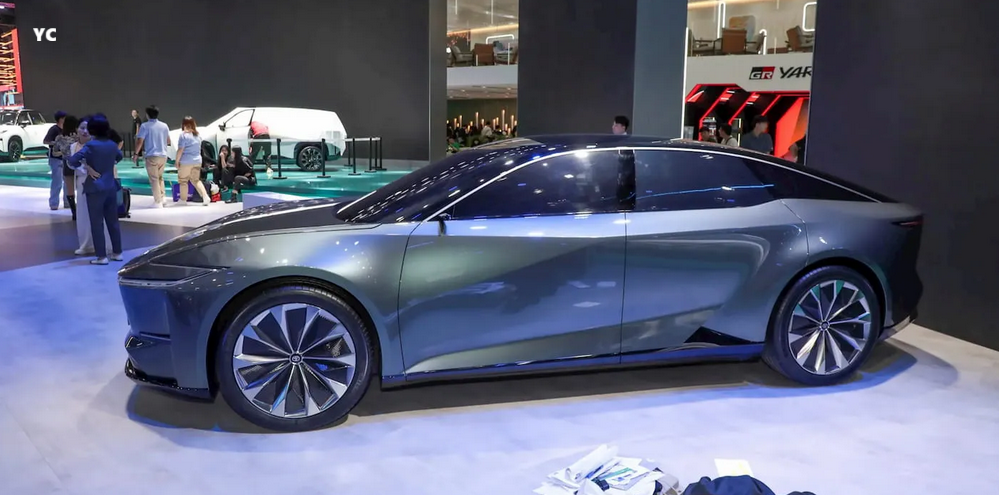
The bZ7 follows Toyota’s newest EV design language, first seen on the bZ3X. Its exterior combines a futuristic style with aerodynamic efficiency. At the front, the car uses a split-headlight design, where the main headlights blend neatly into air ducts on both sides of the bumper. This combination of styling and function helps reduce wind resistance, which improves driving efficiency and stability.
The front bumper has a sculpted, exaggerated shape that channels airflow smoothly across the vehicle. Sitting atop the roof is the LiDAR module, giving the bZ7 an instantly recognizable high-tech look. From the front alone, it’s clear Toyota is positioning this sedan as a modern, intelligent EV made for urban and highway environments.
Long, Sleek Side Profile
From the side, the bZ7 offers an extended and elegant silhouette. Its length is emphasized by a three-dimensional waistline that runs across the body, creating depth and movement. The sedan also features semi-hidden door handles, a growing trend among premium EVs because they improve aerodynamics while adding a minimalist, clean appearance.
Large wheels add to the vehicle’s athletic stance. With a length of 5130 mm, a width of 1965 mm, and a height of 1506 mm, the bZ7 clearly belongs in the mid-to-large EV category. Its long 3020 mm wheelbase means more interior space, ensuring that rear passengers also enjoy a comfortable, luxurious ride.
Elegant Coupe-Like Rear
At the rear, the bZ7 continues its modern design with a coupe-style roofline that slopes smoothly into the trunk. The panoramic roof stretches all the way from the front to the rear window, increasing openness inside the cabin and allowing more natural light.
The back of the car features a full-width taillight strip—a signature styling choice for many next-generation EVs. Above the taillights, a sporty spoiler adds a touch of dynamic character while supporting airflow. On the sides of the rear bumper, air ducts reinforce the vehicle’s performance-inspired look.
A Smart, Modern Interior Powered by HarmonyOS
Inside, the bZ7 introduces one of the biggest upgrades drivers will immediately notice: a large central screen running Huawei HarmonyOS. This marks the first time GAC-Toyota has used HarmonyOS, and it dramatically changes the digital experience for the driver and passengers.
The interface is fast, intuitive, and capable of seamless device connectivity. Users familiar with Huawei devices will find the system easy to navigate thanks to consistent design language and smooth animations. From navigation to entertainment to smart home connections, HarmonyOS creates an ecosystem experience inside the car.
The bZ7 also includes other advanced technologies, such as:
-
Facial recognition for personalized driver settings
-
A heads-up display (HUD) that projects essential information in the driver’s line of sight
-
A premium multi-speaker audio system
-
Clean, minimalist interior styling that emphasizes simplicity and comfort
Overall, the cabin is designed to feel like a modern digital living space, not just a place to drive.
Advanced Assisted Driving With Momenta Technology
For advanced driver assistance, the bZ7 incorporates Momenta’s integrated, end-to-end intelligent driving system. This system relies on AI-driven large models rather than traditional rule-based algorithms. As a result, the assisted-driving experience is designed to be smoother, smarter, and more adaptable.
The combination of LiDAR, multiple sensors, and Momenta’s intelligent model enables the car to support high-level driving assistance on both city roads and highways. This includes features such as lane-changing assist, complex urban traffic handling, automatic merging, and safer obstacle detection.
With these capabilities, Toyota aims to elevate the bZ7 into the league of competitive intelligent electric sedans in China—a segment where technology and driver-assistance performance are major buying factors.
Powertrain and Battery Options
Powering the bZ7 is Huawei’s DriveONE electric motor system, which delivers a maximum output of 207 kW (278 hp). While the car isn’t designed to be sporty, it offers strong and consistent performance suitable for daily driving and long-distance cruising.
The sedan uses CALB’s lithium-iron phosphate (LFP) battery packs, known for long life, safety, and thermal stability. Toyota will offer two battery choices:
-
71.35 kWh battery pack
-
Up to 600 km CLTC range
-
-
88.13 kWh battery pack
-
Range options of 680 km, 700 km, or 710 km (CLTC)
-
These numbers position the bZ7 as a long-range electric sedan capable of meeting the driving needs of both families and business users.
The vehicle has a top speed of 180 km/h, which aligns with most large electric sedans focused on comfort and efficiency rather than performance racing.
Market Launch
GAC-Toyota has confirmed that the bZ7 will officially enter the Chinese market within this year. With its blend of intelligent features, long driving range, spacious interior, and strong electrification technology, the bZ7 represents an important step for Toyota as it competes with local Chinese EV brands.
Its integration of HarmonyOS, advanced LiDAR, and Momenta-powered assisted driving shows Toyota’s willingness to deeply localize its products—a key strategy for success in China’s competitive EV landscape.