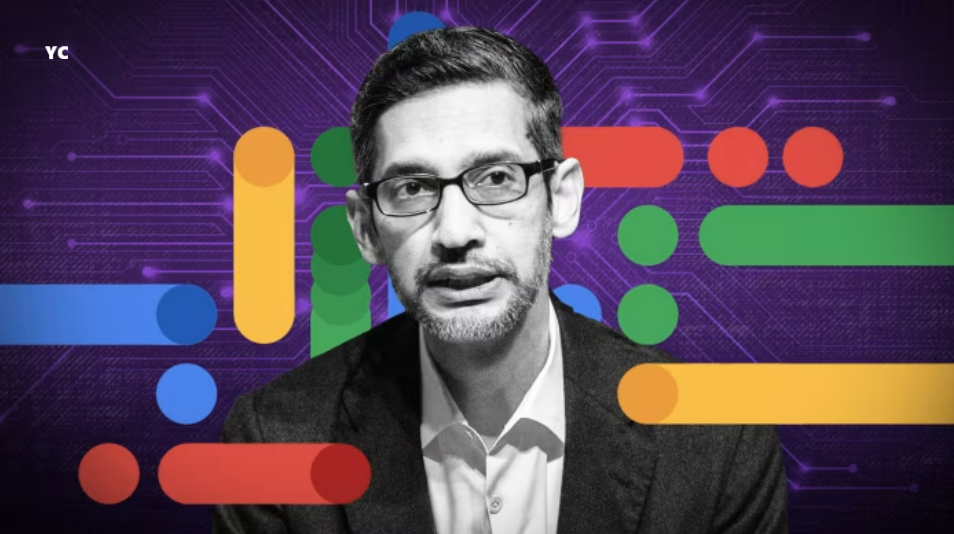
The global race to lead artificial intelligence (AI) is intensifying, and Google CEO Sundar Pichai has issued a clear and urgent warning: the United States risks losing its competitive edge to China if it continues with fragmented, state-level AI regulations. Pichai argues that inconsistent laws across the country could slow innovation, while China’s centralized approach allows it to move rapidly and decisively.
During a recent interview on Fox News Sunday, Pichai highlighted a growing challenge: more than 1,000 AI-related bills are currently circulating in state legislatures across the U.S. While these efforts often aim to protect consumers and prevent misuse, their lack of uniformity has created a confusing and complex regulatory environment. This patchwork, Pichai warned, may inadvertently hinder U.S. companies trying to compete on the global stage.
“How can American companies compete internationally when every state has different rules, while China moves forward under a unified national strategy?” Pichai asked. The answer, he emphasized, is clear: the U.S. needs federal leadership to create a cohesive AI policy framework rather than leaving regulation to dozens of separate states.
The Need for Balance in AI Regulation
Pichai stressed that regulation must strike the right balance. Overregulation could slow innovation, preventing companies from experimenting with new AI tools. Conversely, under-regulation could expose society to serious risks, including misuse of AI for fraud, cyberattacks, or other malicious purposes. A well-crafted national framework could encourage innovation while setting clear boundaries to protect the public.
“Finding this balance is essential,” Pichai said. “We need regulations that guide the technology responsibly, but also allow innovation to flourish. The U.S. cannot afford a fragmented approach while other countries advance rapidly.”
China’s Rapid AI Advancement
The urgency of Pichai’s warning is underscored by China’s aggressive AI investments. The country has poured billions of dollars into research, digital infrastructure, and AI-driven projects, positioning itself as a formidable competitor in the global AI landscape. While China executes a coordinated national strategy, Western nations—including the U.S.—continue to debate the best regulatory approach, potentially leaving the U.S. at a disadvantage in the race for technological leadership.
“China is moving fast,” Pichai said. “We need to ensure that the U.S. is not left behind because of inconsistent state-level rules.”
International Cooperation and AI Security
Beyond domestic regulation, Pichai emphasized the importance of international collaboration. AI is a dual-use technology: it can drive innovation and efficiency but also be misused by cybercriminals, hackers, or state-sponsored actors. Governments and tech companies must work together to develop shared standards and safeguards to prevent the weaponization of AI.
Pichai stressed that companies like Google also have a responsibility to improve security. Google has developed SynthID, an AI tool from Google DeepMind that can detect and label AI-generated images and videos. This technology helps prevent the spread of misinformation, deepfakes, and fraudulent content, demonstrating how AI can be leveraged defensively.
During the interview, Pichai referenced a recent court ruling in Google’s favor. The case involved a phishing operator who targeted over a million people in more than 100 countries. He used this example to show how AI can detect and neutralize criminal operations.
“Just as bad actors can use AI to their advantage, we can use AI to detect and stop harmful activity,” Pichai said, highlighting the defensive potential of artificial intelligence.
The Suncatcher Project: AI Meets Sustainability
Pichai also discussed Google’s ambitious Suncatcher project, which envisions solar-powered AI data centers in outer space. As AI models become more complex and energy-intensive, innovative solutions are needed to sustain future computing requirements. Pichai predicts that within the next decade, space-based AI data centers could become a common way to power AI infrastructure sustainably.
“This is about preparing for the next generation of computing,” he explained. “AI is becoming more demanding, and we need to explore bold solutions that don’t compromise sustainability.”
AI and Human Creativity
Concerns about AI’s impact on human creativity are common. Critics fear that reliance on AI might reduce critical thinking or diminish human ingenuity. Pichai, however, compared this to early skepticism around Google Search 25 years ago. At the time, many questioned whether search engines would make humans less knowledgeable. Instead, society adapted, and technology expanded human capabilities.
“I believe AI will enhance creativity, not replace it,” Pichai said. “It’s a tool that can help us think more deeply, create more, and innovate further.”
Market Dynamics and the AI Investment Boom
Pichai also addressed concerns about the rapid growth of AI-related investments. Companies like Nvidia, OpenAI, and Google have seen valuations soar, prompting speculation about a potential AI bubble. While he acknowledged signs of market “irrationality,” Pichai drew comparisons to the dot-com era of the late 1990s.
“During the dot-com boom, there was excess investment, but the internet ultimately transformed the world,” he said. “I believe AI will follow a similar path. There will be hype, mistakes, and overspending, but the technology itself will redefine industries.”
Alphabet, Google’s parent company, has seen its market value double in just seven months, reaching nearly $3.5 trillion. This growth reflects investor confidence in Google’s ability to remain competitive against emerging AI companies. Still, Pichai warned that no company, including Google, is immune to potential market corrections.
Looking Ahead: Responsible AI Development
Despite the risks, Pichai remains optimistic about the potential of AI. He envisions a future where AI enhances scientific research, improves healthcare, strengthens creativity, and integrates seamlessly into daily life. Achieving this potential, he emphasized, requires responsible development, clear regulations, and international collaboration.
“The decisions we make today about AI policy and innovation will determine our leadership for decades to come,” he said.
Pichai’s message to policymakers was unambiguous: if the U.S. wants to maintain global leadership in AI, it must act now. Coordinated national policies are essential to prevent fragmented regulations from slowing innovation and giving competitors an advantage.
AI as a Strategic Asset
The implications of Pichai’s warning extend beyond technology. AI has become a strategic asset capable of shaping global economic and geopolitical dynamics. Countries that fail to invest in AI infrastructure or align policies risk losing both technological and economic influence.
Moreover, the dual-use nature of AI underscores the importance of ethical and safe deployment. While AI has tremendous societal benefits, it can also be weaponized. Governments, corporations, and international organizations must work together to create frameworks ensuring that AI is used responsibly.
Google continues to lead in this space, investing heavily in research and infrastructure while pioneering ethical deployment strategies. From SynthID’s AI content verification to the futuristic Suncatcher project, the company demonstrates that AI innovation and responsibility can go hand in hand.
Conclusion
Sundar Pichai’s warning highlights the urgency for the United States to clarify its AI regulatory framework and strengthen its capabilities. Without coordinated national leadership, fragmented state-level rules could impede innovation and allow other nations, particularly China, to gain a competitive edge.
At the same time, international collaboration, responsible AI development, and proactive security measures are essential to harness AI’s full potential while minimizing risks. The global AI race has already begun, and the decisions made today will determine whether the United States remains a leader—or falls behind in shaping the AI-driven future of the 21st century.